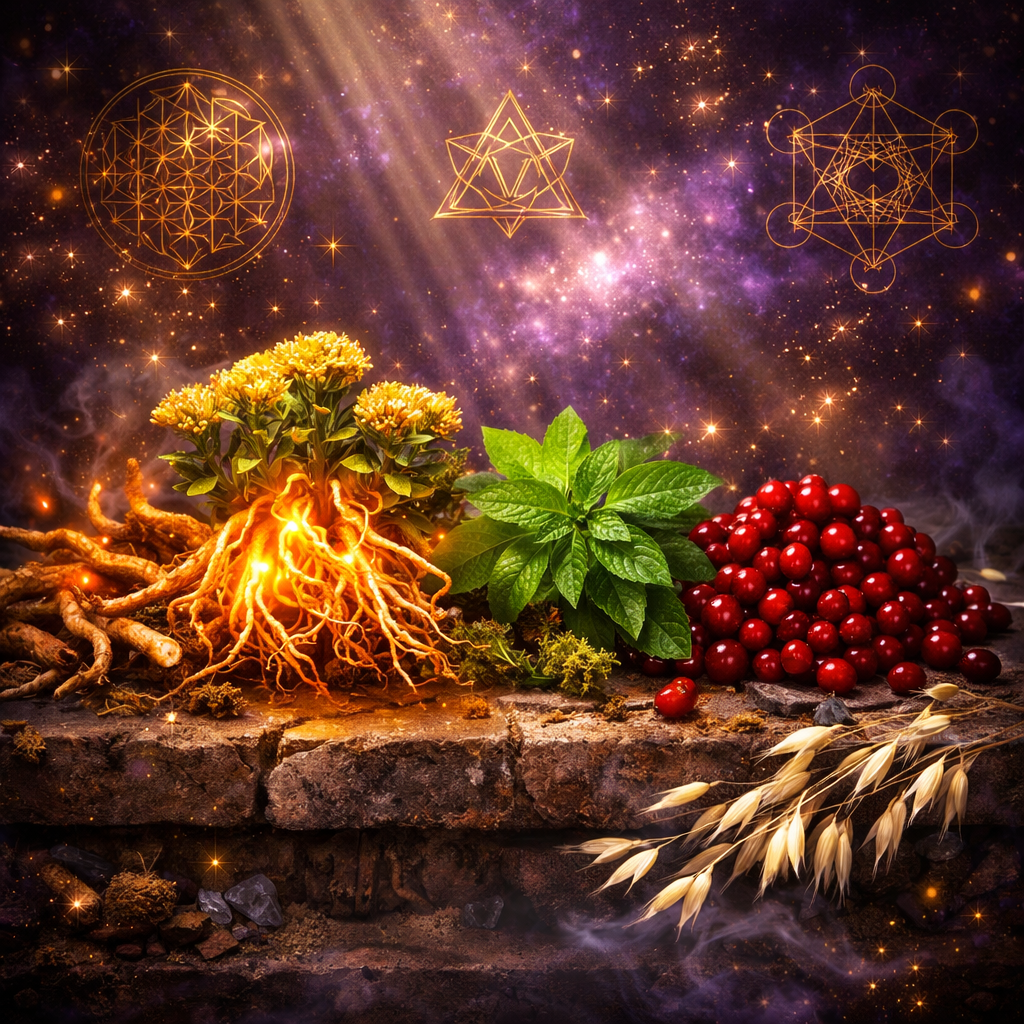
You don't just feel stressed. You are under biological siege.
Your HPA axis—the hypothalamic-pituitary-adrenal system, the body's ancient command center for survival—was never designed for the particular torture of the modern world: the relentless ping of notifications, the mortgage, the performance review, the 2 AM scroll through other people's curated lives. It was built for a lion. You give it a quarterly earnings call, a family group chat, and a calendar with no white space. And so it fires, and fires, and fires. Cortisol floods the bloodstream. Sleep fractures. The immune system quietly surrenders. The nervous system never gets to rest.
This is not burnout as metaphor. It is physiology. And the plants have known the remedy for a very long time.
What Adaptogens Actually Do
Forget the wellness-influencer version for a moment.
Adaptogens are not a trend. They are a pharmacological category—plants that help the body resist and recover from stressors, physical, chemical, and biological, without the crash or dependency of synthetic intervention. The term was formalized by Soviet researcher Nikolai Lazarev in 1947, but the plants themselves were old long before the USSR existed. Rhodiola rosea grew in the Arctic tundra and was traded among Viking explorers. Ashwagandha was documented in the Charaka Samhita, the foundational text of Ayurvedic medicine, over 3,000 years ago. Holy basil—tulsi—is literally sacred in Hindu tradition, planted outside homes and temples as a protector of life force.
What they share is a capacity to modulate the stress response rather than suppress it. They don't sedate. They don't spike. They recalibrate. Specifically, they appear to influence the HPA axis—the same system your chronic stress is currently dismantling—by regulating the feedback loops that govern cortisol production, adrenal function, and the nervous system's ability to return to baseline after activation.
Think of them not as switches, but as tuners. Ancient instruments for a system that has forgotten its own frequency.
The Study That Changes Everything
For centuries, the wisdom lived in oral tradition, in Ayurvedic texts, in the practice of monks and healers who simply knew. Now it lives in a randomized, double-blind, placebo-controlled clinical trial published in February 2026.
The study, conducted by McKinney, Stewart, Kewalramani, and Singh, enrolled 186 adults aged 18–65 with clinically significant perceived stress scores. Participants were randomized into three groups over 60 days: one group received a multi-herb adaptogen blend (Rhodiola rosea + holy basil + Schisandra + milky oat + ashwagandha), a second group received a full-spectrum ashwagandha extract, and a third received placebo. The methodology was rigorous—double-blind, double-dummy design, with compliance tracked via capsule counts and daily diaries.
The results were striking.
By day 60, both adaptogen formulas produced statistically significant reductions in perceived stress compared to placebo (p<0.0001). 85–89% of participants in the adaptogen groups shifted from high stress to moderate stress categories—compared to only 44% in the placebo group. Fatigue dropped significantly. Anxiety scores (measured on the DASS-21 scale) fell sharply. Sleep quality improved on multiple dimensions: time to fall asleep, subjective quality, daytime functioning. Restorative sleep scores in both adaptogen groups improved by more than 17 points versus roughly 9 in placebo.
The effect sizes were not trivial. The full-spectrum ashwagandha extract produced a Cohen's d of 0.94 on stress reduction—approaching the range typically classified as "large" in clinical research. The multi-herb blend registered 0.71. These are meaningful, real-world numbers.
No serious adverse events were recorded. No dependency signals. No hormonal disruption. Just plants, doing what they have always done.
The Five Sacred Adaptogens
Rhodiola Rosea — The Golden Root
It grew where almost nothing else could: the cliffs of Siberia, the mountains of Scandinavia, the high altitude reaches of Central Asia. Rhodiola was carried by Viking warriors before raids and gifted to couples on their wedding night as a fertility talisman. Its active compounds—rosavins and salidroside—are now understood to modulate the stress-response enzyme system at the cellular level, reducing the production of cortisol and stress-activated proteins while supporting mitochondrial energy production. In the 2026 trial, the multi-herb formula was standardized to 6 mg total rosavins per serving. For thousands of years before that number existed, people simply knew the root helped them hold together under pressure.
Holy Basil — Tulsi, the Incomparable One
In Sanskrit it means the incomparable. In pharmacology, it is classified as an adaptogen, an anxiolytic, and an anti-inflammatory simultaneously. Holy basil (Ocimum sanctum) is not the basil in your pasta. It is a different species entirely—peppery, clove-like, slightly medicinal. In India it has been planted outside homes for millennia not merely for ritual, but because living near it, drinking it as tea, and using it in cooking was understood to protect against disease, calm the mind, and support the breath. Modern research points to its eugenol content as a primary active compound, which appears to act on the nervous system's stress response pathways. In the clinical trial, it was standardized to 4–6 mg eugenol per serving. The monks knew, without the spectroscopy.
Schisandra Chinensis — The Five-Flavor Berry
This is the one most people in the West have never heard of. Schisandra—the wu wei zi, or "five-flavor fruit" in Chinese medicine—is said to contain all five fundamental tastes simultaneously: sweet, sour, salty, bitter, and pungent. In traditional Chinese medicine this was not considered strange. It was considered whole. Schisandra has been used for over 2,000 years as a tonic for the liver, the lungs, and the kidneys—the organs TCM associates with resilience and life force. Adaptogens for stress work in concert, not isolation, and Schisandra's role in the multi-herb formula reflects this ancient understanding of synergy. It does not steal the spotlight. It deepens the chord.
Ashwagandha — The Sleep of the Horse
The name translates roughly as "smell of horse"—but more poetically it implies the strength and vitality of one. Withania somnifera: the sleep-bringer. Ashwagandha is the most clinically studied adaptogen in the Western literature, and the 2026 trial reinforces its status. The full-spectrum ashwagandha extract produced the largest individual effect size in the study—nearly a full standard deviation of stress reduction above placebo. Its active compounds, withanolides, appear to act as cortisol modulators and GABA-mimetic agents, meaning they influence both the stress hormone system and the calming neurotransmitter system simultaneously. In Ayurvedic tradition it was given to children for strength, to the elderly for longevity, and to adults navigating difficulty—for the particular grace of horses: powerful, yet able to rest.
Milky Oat — The Nervous System's Lullaby
Avena sativa, harvested in its milky stage before the grain fully sets, is perhaps the quietest of the five. It does not shout. It holds. Milky oat has a long history in Western herbalism as a nervine—a plant that nourishes and restores the nervous system after depletion. Where rhodiola and ashwagandha modulate the stress response actively, milky oat tends to the aftermath: the frayed nerves, the adrenal exhaustion, the low hum of chronic overwhelm. Its inclusion in the multi-herb formula speaks to a sophisticated understanding of the stress cycle—that resilience is not just about managing the acute spike, but about rebuilding the capacity to return to ease.
How to Use This Knowledge
The 2026 study used 350 mg capsules of each formula, taken twice daily—morning and evening, with food—for 60 days. Meaningful shifts in stress category were visible as early as day 30, with the most significant results by day 60. This is not a supplement you take for a weekend and assess on Monday morning.
Consistency over intensity. Adaptogens build their effect over time. Daily use over 4–8 weeks is the frame within which clinical research observes results. A single dose is not the unit of measure; a practice is.
Morning and evening timing matters. The HPA axis follows a circadian rhythm—cortisol peaks in the morning, tapers through the day. Adaptogenic support taken twice daily, aligned with the body's natural hormonal rhythm, mirrors the study's protocol and the traditional usage patterns of most of these plants.
Combination or single-herb? The trial suggests both approaches work. The multi-herb formula showed stronger mood effects and sustained stress reduction. The full-spectrum ashwagandha showed faster early improvements. Individual biochemistry varies. Both are legitimate starting points.
Quality of extract matters. The study used standardized extracts—5% rosavins for rhodiola, 4.5% eugenol for holy basil, ≥2.5 mg withanolides for ashwagandha. When choosing a supplement, look for standardization information on the label. It signals that what's inside reflects what was studied.
Disclaimer: This post is for educational and informational purposes only and does not constitute medical advice. Consult a qualified healthcare practitioner before adding any supplement to your routine, particularly if you are pregnant, nursing, managing a chronic health condition, or taking prescription medications.
The Ancient and the Proven
At SoulEnergy144, we believe the divide between ancient wisdom and modern science is a false one—a temporary artifact of a culture that forgot its origins and is slowly, haltingly remembering them.
The HPA axis does not care whether its support comes from a monastery garden in the Himalayas or a clinical laboratory in Mumbai. The body is not impressed by the century of the remedy. It is only ever asking one question: does this help?
The 2026 trial offers one of the clearest answers yet: yes. Measurably, significantly, safely. Eighty-nine percent of people on the ashwagandha formula moved out of the high-stress category in 60 days. That is not a testimonial. That is data. But the plants themselves are older than data, older than the concept of a clinical trial, older than the word "supplement."
They have been waiting for us to catch up.
We are, finally, beginning to.
Source: McKinney E, Stewart J, Kewalramani R, Singh S. "Effects of multi-herb and ashwagandha root formulas on stress, sleep, fatigue, and anxiety in adults with elevated perceived stress: a randomized double-blind, placebo-controlled trial." Trials (2026). Published February 9, 2026.